1. Siddhartha Gautama
2. Old age, disease, death, and an ascetic. The first three sights were penetrating lessons about the reality of suffering and the impermanent nature of life's pleasures. The fourth passing sight filled Gautama with elation and hope.
3. A healthy spiritual life depends on a healthy physical life.
4. He first experienced the First Watch (evening) he perceived his own previous lifetimes. During the Second Watch (middle of the night) he was able to perceive the deaths and rebirths of all living things. During the Third Watch (late night) he discovered the Four Noble Truths.
5. The sangha was the first Buddhist monastic community. Its members are consists of men and women from all walks of life.
6. Buddha, dharma, and sangha.
7. They both regard time as cyclical. They maintain that the universe is eternal. They both believe in samsara.
8. The Buddha dismissed philosophical speculation regarding the nature of the world as being useless for the tasks of winning salvation. He thought sacrificial rituals of devotion to gods were equally useless.
9. Anatta, anicca, and dukkha. Impermanence (anicca) cause human beings to be nothing (anatta), and if there is no self, then there is no need for one to suffer (dukkha) because desires are nonexistent if the self does not exist.
10. Anatta means there is no ultimate reality within, no essence, underlying existence, no eternal substratum that is truly real. It means there is no self. It relates to the concept of Atman because in Hinduism, the goal is to find Atman within and be absorbed in it, as opposed to anatta, which focuses on the idea of there being no self, therefore there is no need to find anything.
11. It is the transference of a bundle of energy, which is patterned according to one's karma. The nature of one's rebirth depends on the status of one's karma.
12. Precepts: 1. Do not take life 2. Do not take what is not given 3. Do not engage in sensuous misconduct. 4. Do not use false speech. 5. Do not drink intoxicants. Other 5: 6. Do not eat after noon. 7. Do not watch dancing or shows. 8. Do not use garlands, perfumes, or ornaments. 9. Do not use a high or soft bed. 10. Do not accept gold silver.
13. It can be translated into "suffering," "frustration," "dislocation," or "discomfort." Dukkha means that things in life are not where they should be, therefore one undergoes suffering due to the misplacement.
14. Tanha is "desire," "thirst," or "craving." We have desires because we are attached to the things, and when we are without those attachments we encounter suffering (dukkha) due to the detachment we face from our pleasures.
15. 1. Right views 2. Right intentions 3. Right speech 4. Right conduct 5. Right livelihood 6. Right effort 7. Right mindfulness 8. Right meditation
16. Buddhas are different from their followers because the do not need a model to provide teachings leading to their awakening. They are able to accomplish their liberation on their own.
17. An arhat is known as the "worthy one" who has become awakened, is forever transformed, having experienced, through the transcendent state of enlightenment.
18. The literal meaning of nirvana is "blowing out." It is hard to describe nirvana because it can;t be understood until it is experienced. The most that can be said is that it is the total cessation of suffering, and thus is absolute peace.
19. The three divisions are Theravada, Mahayana, and Vajrayana.
20. Theravada follows the earlier texts, and thus tends to agree with the original teachings of the Buddha.
21. The literal meaning of Mahayana is the Great Vehicle. The name implies its superiority over Theravada Buddhism. It's the largest division pf Buddhism, claiming well over half the world's Buddhists.
22. Buddhist teachings prescribe shutting off the energy of desire to stop suffering.
23. The Dalai Lama is the head of the lamas institution. The role of acquiring the Dalai Lama is through rebirth. The lineage is believed to continue through the reincarnation of one Dalai Lama into the next. When the Dalai Lama dies, his successor is chosen through various mean such as supernatural things or more mundane things.
24. Cambodia, Sri Lanka, Burma, Thailand, China, Japan, Korea, and Tibet.
Thursday, February 28, 2013

Saturday, February 9, 2013
Introduction to Buddhism
The Buddha was born as Siddhartha Gautama in Nepal. He was born into wealth. His family was a royal family of a small kingdom of the Indian-Nepalese border. He had a comfortable upbringing, but his attachment to material things was disrupted when he discovered old age, sickness, and death. His exposure to such morbid views caused him to question the meaning of life. His reaction to the world's sadness inspired him to leave his kush life and adopt the traditional Indian path of the wandering holy man. The goal was to find the Truth of life. His new conversion of life transformed him into a devotee of meditation. After a while, he lived out ascetic practices. He was so devoted to his lifestyle that he began to starve himself. Despite his mission in engaging in various methods, he wasn't able to solve the mystery of life and death. He came to realize that he needed to try something different. So he decided to look into his heart and mind, where he used direct experience and intuition to be his guide to the Truth. In order to reach Enlightenment, he sat under a pipal tree for 40 days. After the extended days, he finally reached Freedom. Throughout the the 45 years of his life, the Buddha traveled through India to spread his understanding. His influence touched all types of people, resulting in some of his disciples reaching Enlightenment. He is seen as a model for Buddhists to emulate in order to reach Enlightenment.
The 'Three Jewels' are seen as integral ideals in Buddhism. They consist of the Buddha, Dharma, and Sangha. Incorporating these three jewels is the key to becoming a Buddha. The Buddha is the yellow jewel and it refers to Buddha and Buddhahood. Going for refuge to the Buddha is using him as your model in your life. Engaging in this allows you to accomplish Buddhahood. The goal of this is to coherently view the nature of reality. Dharma refers to the teachings of the Buddha. It is also the teaching that was created when the Buddha actualized his knowledge and taught it to others (his Enlightenment). Dharma is also the practices that are written down in the scriptures. The Sangha is the spiritual community. It also pertains to the people you share your spiritual live with.The support and guidance of other people will help you reach your path towards Enlightenment.
The Threefold Way consists of ethics, meditation, and wisdom. The ethical code known as Five Percepts are 'principles of training'. Wisdom will help you understand reality. Meditation helps transform the mind. It also helps bring about concentration, clarity, emotional positivity, and a clear view of reality.
The first noble truth is that "All existence is dukkha". This idea focuses on the sufferings of life. Existence is difficult, and it brings hardships and suffering. The second truth is that we suffer because we have desires. The third truth is that in order to stop our suffering, we need to eliminate our desires. Lastly, in order to eliminate our desires we need to follow the Noble Eightfold Path.
The Eightfold Path consists of: 1. Right Understanding or Perfect Vision 2. Right Resolve or PErfect Emotion 3. Right Speech or Perfect Speech 4. Right Action or Perfect Action 5. Right Livelihood or Perfect Livelihood 6. Right Effort or Perfect Effort 7. Right Mindfulness or Perfect Awareness 8. Right Mindness or Perfect Samadhi. It serves as a source of guidance and wisdom to live our lives.
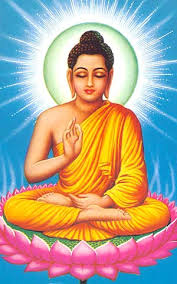
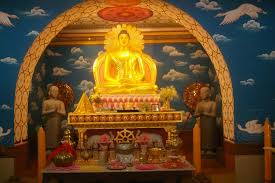

The 'Three Jewels' are seen as integral ideals in Buddhism. They consist of the Buddha, Dharma, and Sangha. Incorporating these three jewels is the key to becoming a Buddha. The Buddha is the yellow jewel and it refers to Buddha and Buddhahood. Going for refuge to the Buddha is using him as your model in your life. Engaging in this allows you to accomplish Buddhahood. The goal of this is to coherently view the nature of reality. Dharma refers to the teachings of the Buddha. It is also the teaching that was created when the Buddha actualized his knowledge and taught it to others (his Enlightenment). Dharma is also the practices that are written down in the scriptures. The Sangha is the spiritual community. It also pertains to the people you share your spiritual live with.The support and guidance of other people will help you reach your path towards Enlightenment.
The Threefold Way consists of ethics, meditation, and wisdom. The ethical code known as Five Percepts are 'principles of training'. Wisdom will help you understand reality. Meditation helps transform the mind. It also helps bring about concentration, clarity, emotional positivity, and a clear view of reality.
The first noble truth is that "All existence is dukkha". This idea focuses on the sufferings of life. Existence is difficult, and it brings hardships and suffering. The second truth is that we suffer because we have desires. The third truth is that in order to stop our suffering, we need to eliminate our desires. Lastly, in order to eliminate our desires we need to follow the Noble Eightfold Path.
The Eightfold Path consists of: 1. Right Understanding or Perfect Vision 2. Right Resolve or PErfect Emotion 3. Right Speech or Perfect Speech 4. Right Action or Perfect Action 5. Right Livelihood or Perfect Livelihood 6. Right Effort or Perfect Effort 7. Right Mindfulness or Perfect Awareness 8. Right Mindness or Perfect Samadhi. It serves as a source of guidance and wisdom to live our lives.
Monday, February 4, 2013
Hinduism Questions
1.
Moksha is a
release from this ordinary, finite, limited realm of existence into the
infinite ocean of the divine.
2.
The Upanishads
state that Brahman and Atman actually one. Brahman is Atman. All reality id
one. An analogy would be how despite not seeing salt in salt water, it’s still
present. The same goes with Brahman. Even though Hindus do not see Brahman he
is everywhere in the universe.
3.
Brahman is
Atman. All reality—the universe, oneself, and everyone else—shares one essence.
And that one is Brahman. Or Atman as well.
4.
Because the
divine reality of Brahman or Atman is beyond the reach of the senses and of
thought, humans need accessible points of contact with the divine. Hinduism’s
many deities provide these points of contact, each with its own personal
characteristics.
5.
Samsara is known
as the “wheel of rebirth, “ the individual is reincarnated from one life-form
to another.
6.
The
Bhagavad-Gita is Hinduism’s most popular sacred text.
7.
Karma and dharma
connect the divine with this world. Karma determine the nature of each
reincarnation. It states that every action produces an outcome that is justified
by the action’s moral worthiness. Karma determines all he particular
circumstances and situations of one’s life. It holds people responsible for
their actions. Dharma is the ethical duty based on the divine order of reality.
Dharma is the complete rule of life.
8.
The four classes
of the caste system are Brahmin which consists of priests; kshatriya which
consists of warriors and administrators; vaishya which consists of farmers,
merchants, and artisans, and shudra which consists of servants and laborers.
9.
Krishna
encourages Arjuna to engage in war because Arjuna needs to fulfill his duty.
The battle of a sacred duty is beneficial. Abandoning his duty would only hurt
him rather than save him.
10. The first stage is the stage of a student. It last
until marriage, while the student studies the Vedas and other sacred literature.
The second stage is the householder. This stage consists of pursuing a career
and raising a family. The beginning of the third stage is the birth of a
grandchild, which is known as the forest dweller stage. During this stage, a
man retreats from worldly bonds in order to engage fully in a spiritual quest.
The fourth stage is the sannyasin or wandering ascetic. It is for forest dwellers
who are engaged in the world, but not attached to it.
11. Kama is a goal of life. Kama consists of pleasure. A
next goal is artha, or material success. Yearning for artha leads to the goal
of dharma, which is the duty of each Hinduu. The last goal is to reach moksha
which is the release to a an infinite world.
12. The three paths to liberation are to be active, to
gain knowledge, and to experience emotional attachment. The "active path"
is for those engaged in the day-to-day tasks of earning a living and raising a family.
"The Path of Knowledge" is intended for those with talent for philosophical
reflection. It requires the follower to devote a great deal of time to learning
and meditation. "The Path of Devotion"(emotional attachment) is most suitable
for those to whom emotional attachment comes naturally. Worship requires a focusing
of attention on the divine, and away from the adherent's selfish concerns.
13. The three most important schools of Hindu philosophy
are Vedanta, Sankhya, and Yoga. The three approaches are in harmony regarding the
attainment of knowledge over the ignorance that binds the self to samsara.
14. Three important gods and goddesses are Brahma, Vishnu,
and Shiva.
15. An avatar is an incarnation, or living embodiment, of a deity, commonly of Vishnu, who is sent to earth to accomplish. Krishna is an avatar of Vishnu. Rama is another avatar; he's the hero of the Ramayana which is an epic poem from ancient times that has a big influence on Hindus.
16. The Bhagavad-Gita is most closely associated with bhakti marga.
17. Household and village rituals, holy places, and cow veneration are three aspects of Hindu devotional life.
18. Mahatma Gandhi was a religious reformer. He helped India gain independence. His insights continue to fuel Hinduism's tendency to accept all wisdom as lighting the way to the divine.
19. The Indian government in 1948 officially forbade the discrimination against outcastes. Governmental programs have been created to further promote the economic and social rights of the marginalized people.
20. Sati is the burning of a widow. Since 1829, sati has been officially forbidden. It does still occur, but rarely.
21 In 1974, the Indian Partition caused Muslims and Hindus to fight each other as the two parties traveled to either Pakistan or India.
15. An avatar is an incarnation, or living embodiment, of a deity, commonly of Vishnu, who is sent to earth to accomplish. Krishna is an avatar of Vishnu. Rama is another avatar; he's the hero of the Ramayana which is an epic poem from ancient times that has a big influence on Hindus.
16. The Bhagavad-Gita is most closely associated with bhakti marga.
17. Household and village rituals, holy places, and cow veneration are three aspects of Hindu devotional life.
18. Mahatma Gandhi was a religious reformer. He helped India gain independence. His insights continue to fuel Hinduism's tendency to accept all wisdom as lighting the way to the divine.
19. The Indian government in 1948 officially forbade the discrimination against outcastes. Governmental programs have been created to further promote the economic and social rights of the marginalized people.
20. Sati is the burning of a widow. Since 1829, sati has been officially forbidden. It does still occur, but rarely.
21 In 1974, the Indian Partition caused Muslims and Hindus to fight each other as the two parties traveled to either Pakistan or India.
Subscribe to:
Comments (Atom)